
People love character chat. They want fun talks and deep stories. Janitor AI made this popular. Still, limits frustrate users. Many now search for janitor AI alternatives. These tools feel freer. They last longer. They give more control.
Fans compare janitor AI alternatives every day. They want better memory. They want stable roleplay. Janitor AI alternatives support long chats. They feel more human. Some allow private bots. Others offer custom models. That flexibility matters.
When choosing janitor AI alternatives, think simple. Look at the cost. Check safety. Janitor AI alternatives differ a lot. Some focus on fun. Some focus on control. The best janitor AI alternatives fit your style. You stay engaged. You keep chatting. That is why janitor AI alternatives keep growing fast worldwide today. Users trust Janitor AI alternatives for daily creative escape. They feel open and flexible now.
What is Janitor AI?
Janitor AI is a character-based chatbot platform built for conversation and roleplay. It lets you chat with fictional characters in many styles. People use it for storytelling, emotional support, and casual fun. The system relies on large language models to generate replies. Users design personas using prompts, traits, and backstories. These details shape how characters talk and react over time. Long chats can feel immersive and personal. Many users enjoy creating deep, story-driven conversations.
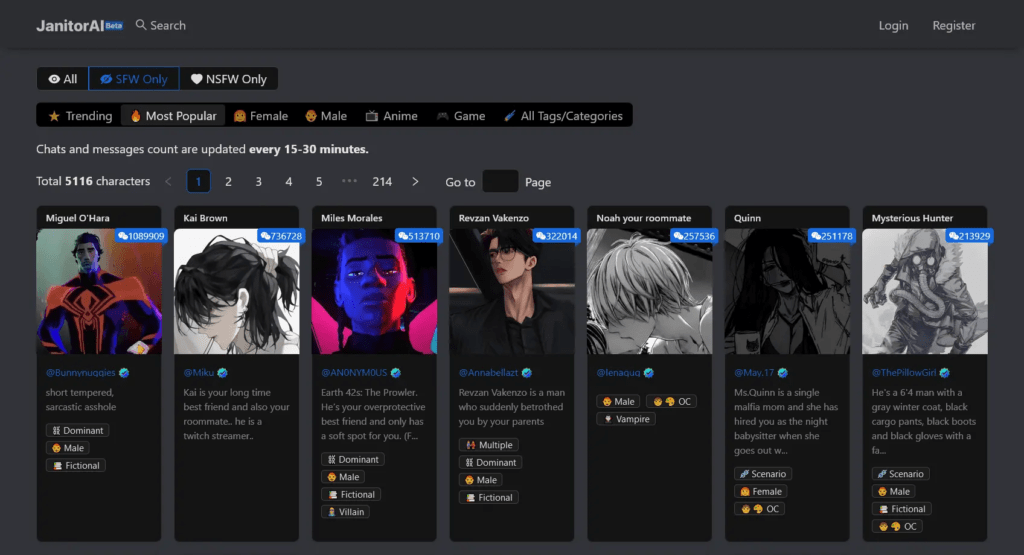
Janitor AI works mainly through a web-based interface. It uses tokens and a context window to generate responses. When chats get long, memory limits can appear. Some features depend on external model APIs and token billing. Community-created bots add variety and creativity. Users can discover new characters easily. However, usage limits push many people to explore other platforms.
How Janitor AI Works?
Janitor AI runs on large language models that generate replies in real time. You type messages, and the system interprets your intent to respond naturally. Prompts guide each character’s personality, tone, and behavior. System prompts set safety rules and response style. The context window keeps track of recent chat to maintain continuity. Tokens manage response length, memory usage, and speed, ensuring the conversation flows smoothly.
External model APIs connect extra features and expand capabilities. API keys allow secure access and track token usage. Token billing helps manage costs and usage limits. Community bots use templates, lorebooks, and scenarios to enrich roleplay. Model routing selects the best engine for speed and quality. These mechanics explain why many users explore Janitor AI alternatives for longer, more flexible chats.
Where Cost Really Comes From (& Why “Free” can Flip)
Many people assume free AI chatbots cost nothing. In reality, running AI models requires heavy computing power. Servers, GPUs, and storage all add up. Every chat consumes tokens, which companies must pay for. Even if you don’t see a bill, someone is covering the cost. That’s why “free” plans often have hidden limits or slower responses.
When usage grows, companies may switch from free to paid models. Token-based pricing or subscription tiers help control expenses. Features like long-context memory, image generation, and voice calls increase costs. Developers also spend on maintenance, moderation, and updates. This is why unlimited messages are rarely truly unlimited. Understanding this helps users plan and avoid surprises.
Why is Janitor AI popular?
Janitor AI has gained attention for its simple, user-friendly interface. Users can chat with AI characters without complicated setups. It supports roleplay and story-driven conversations, which makes it fun. Many enjoy creating custom personas and exploring different scenarios. The platform also offers free tiers, letting people try it before paying. Its versatility appeals to casual users and AI enthusiasts alike.
The chatbot handles long conversations well, keeping context and character continuity. Developers like its support for external model APIs and BYO-model options. Features like text-to-speech and image generation add extra engagement. Community-driven bots and persona libraries make exploration easier. People also value privacy controls and predictable pricing. These factors combine to make Janitor AI a go-to platform.
How We Picked these Janitor AI Alternatives
We researched many AI chat platforms to find the best Janitor AI alternatives. Our focus was on usability, features, and flexibility. We looked at character-based AI, roleplay capabilities, and long-context stability. Pricing models, privacy, and customization options mattered too. Platforms that offered multi-model access and community-driven bots scored higher. We also considered mobile and web usability.
- Tested roleplay workflows for smooth interactions.
- Compared subscription and token-based pricing plans.
- Evaluated long-context memory and conversation continuity.
- Checked BYO-model and multi-model support.
- Assessed text-to-speech and voice call features.
- Reviewed persona creation and character libraries.
- Measured response speed and reliability.
- Verified privacy controls and data handling.
- Explored story-driven chat and scenario building.
- Looked at community-driven and private bot options.
- Analyzed platform accessibility on web and mobile.
- Compared external API integration and tool-calling features.
7 Janitor AI Alternatives (Updated for 2025)
If Janitor AI seems limited, slow, or costly when handling long chats, these 7 alternatives offer similar character-based AI experiences with unique perks: some prioritize long-context memory, others provide advanced roleplay workflows, mobile-first chat, multi-model access, DIY self-hosting, or subscription flexibility, giving creators, teams, and casual users a variety of ways to enjoy AI companions without compromise.
DreamGen (Best overall for long roleplay + story workflows)
DreamGen excels at long-form roleplay and story-driven AI chat. It keeps context well over multiple sessions, so characters stay consistent. Users can create personas, scenarios, and story arcs easily. The platform supports multi-model access and BYO-model options. Mobile and web chat are smooth. Features like text-to-speech and image generation enhance immersion. It also offers subscription and free tiers for flexibility.
| Pros | Cons |
| Strong long-context memory for extended roleplay | Free tier has limited features |
| Easy persona creation and scenario building | Some advanced tools require a paid subscription |
| Multi-model and BYO-model support | Learning curve for beginners |
| Smooth mobile and web experience | Occasional latency with heavy sessions |
| Text-to-speech and image generation | Limited integrations with external APIs |
| Subscription and token-based pricing options | Complex pricing can confuse new users |
Key Features
- Long-Context Memory: Maintains story and character continuity over extended conversations.
- Persona Creation: Allows users to design custom characters with unique traits and personalities.
- Scenario & Story-Building Tools: Let’s you craft story arcs, quests, and roleplay scenarios.
- Multi-Model Access: Supports switching between AI models or using multiple models in one chat.
- BYO-Model Support: Bring your own AI model for more customization and experimentation.
- Text-to-Speech (TTS): Converts chat messages into natural-sounding voice outputs.
- Image Generation: Creates visuals to enhance roleplay and story immersion.
- Mobile & Web Compatibility: Smooth experience across devices, letting users roleplay anytime,
Pricing
DreamGen offers flexible pricing that suits different users, making it a strong contender among Janitor AI alternatives. Free tiers let casual users explore roleplay and story workflows without commitment. Paid subscriptions unlock long-context memory, multi-model access, and advanced persona creation. Token-based options allow precise cost control. Compared to other Janitor AI alternatives, DreamGen provides predictable pricing and spend caps. Its mix of free and paid tiers makes it ideal for both casual users and heavy roleplay enthusiasts seeking value.
Character.AI (Best for discovery + community + voice calls)
Character.AI shines for users who want discovery, community, and interactive voice features. It offers a wide range of character libraries and persona options for roleplay. Users can join communities to share characters, scenarios, and story ideas. Voice calls and text-to-speech enhance immersion. Multi-model support allows experimenting with different AI behaviors. Free and paid tiers give flexibility for casual users and heavy roleplayers alike.
| Pros | Cons |
| Large character libraries for discovery | Free tier limits voice calls and features |
| Strong community for sharing and feedback | It can be overwhelming for new users |
| Voice calls and text-to-speech support | Occasional lag during high traffic |
| Easy persona creation and roleplay tools | Advanced features require a subscription |
| Multi-model access for experimentation | Limited BYO-model support |
| Free and paid tiers for flexible use | Complex pricing structure for beginners |

Key Features
- Large Character Libraries: Explore a wide variety of ready-made characters for roleplay and storytelling.
- Community Sharing: Connect with other users to share characters, scenarios, and story ideas.
- Voice Calls & TTS: Chat with characters using natural-sounding voice features for immersion.
- Persona Creation Tools: Build custom characters with unique traits and personalities.
- Multi-Model Support: Switch between different AI models for varied conversation styles.
- Flexible Tiers: Free and paid plans allow casual users and heavy roleplayers to enjoy the platform.
Pricing
Character.AI offers a mix of free and paid tiers, making it a top choice among Janitor AI alternatives. The free tier lets users explore character libraries and join community chats without cost. Paid subscriptions unlock voice calls, advanced persona creation, and multi-model access. Compared to other Janitor AI alternatives, Character.AI provides predictable pricing and flexible plans. Token-based options allow precise spending for heavy users. This balance of free and paid options keeps it competitive among Janitor AI alternatives for both casual and serious roleplayers.
Poe (Best multi-model alternative + bot building + API)
Poe stands out as a versatile Janitor AI alternative for users who want multi-model access and bot-building capabilities. It supports API integration for developers and creators who need custom AI solutions. The platform handles long chats well and maintains context across sessions. Users can design personas, workflows, and story-driven roleplay. Its web and mobile interfaces are smooth and intuitive. Subscription and token-based pricing provide flexibility for different use cases.
| Pros | Cons |
| Multi-model access for varied AI experiences | Free tier has limited model usage |
| API support for developers and custom bots | Advanced features require technical knowledge |
| Bot-building and persona creation tools | It can be overwhelming for casual users |
| Maintains long-context conversations | Occasional latency during heavy usage |
| Web and mobile-friendly interfaces | Limited text-to-speech and voice features |
| Flexible subscription and token-based pricing | Complex pricing may confuse new users |
Key Features
- Multi-Model Access: Switch between different AI models for varied conversation styles.
- Bot-Building Tools: Create custom AI bots for roleplay, storytelling, or automation.
- API Integration: Connect Poe to external apps or workflows for developers and creators.
- Long-Context Memory: Maintain conversation and character continuity over extended sessions.
- Persona & Scenario Creation: Design unique characters and roleplay scenarios with ease.
- Web & Mobile-Friendly: Smooth interfaces for both desktop and mobile use, enhancing accessibility.
Pricing
DreamGen (Character.AI) offers flexible pricing that makes it one of the top Janitor AI alternatives. Its free tier allows users to explore character libraries, community features, and voice calls without paying. Paid subscriptions unlock advanced persona creation, multi-model access, and priority support. Compared to other Janitor AI alternatives, it provides predictable pricing and flexible spend caps. Token-based options help manage costs for heavy users. These plans make it a strong Janitor AI alternative for both casual users and serious roleplayers.
Chai (Best mobile-first “quick chat” alternative)
Chai focuses on fast, mobile-first AI chat, making it ideal for on-the-go roleplay. It is one of the easiest Janitor AI alternatives for casual users. The platform supports quick character discovery and short story interactions. Users can create custom personas and join community-driven chats. Multi-model support adds variety to conversations. Its subscription and free tiers make it flexible for all users.
| Pros | Cons |
| Mobile-first interface for quick chats | Limited long-context memory |
| Easy persona creation and discovery | Advanced features require a subscription |
| Multi-model support for varied experiences | Short sessions may not suit heavy roleplay |
| Community-driven chat and sharing | Occasional lag during peak usage |
| Free and paid tiers for flexibility | Limited text-to-speech or image generation |
| Quick setup, minimal learning curve | Some customization options are restricted |
Key Features
- Mobile-First Interface – Designed for fast and smooth chats on smartphones and tablets.
- Quick Character Discovery – Easily explore new characters and join short story interactions.
- Persona Creation – Build custom characters with unique traits for casual roleplay.
- Community-Driven Chat – Join community rooms to share characters and scenarios.
- Multi-Model Support – Switch between different AI models for varied conversation styles.
Pricing
Chai offers flexible pricing that makes it a top choice among Janitor AI alternatives. Its free tier lets users enjoy mobile-first quick chats, explore characters, and join community rooms without paying. Paid subscriptions unlock longer chats, advanced persona creation, and multi-model access. Compared to other Janitor AI alternatives, Chai provides predictable spend caps and flexible plans. Token-based options help manage costs for heavy users. These pricing options make Chai a strong Janitor AI alternative for casual and dedicated roleplayers alike.
Sakura AI (Best predictable subscription for “unlimited messages”)
Sakura AI stands out as a Janitor AI alternative with predictable subscription pricing and unlimited messages. It is ideal for users who want continuous roleplay without worrying about token limits. The platform supports persona creation, multi-model access, and long-context memory. Users can enjoy story-driven chat, scenario building, and character continuity. Its mobile and web interfaces are smooth. Free and paid tiers make it flexible for casual and heavy users alike.
| Pros | Cons |
| Predictable subscription with unlimited messages | Free tier has limited features |
| Long-context memory for continuous roleplay | Advanced features require a paid subscription |
| Persona creation and scenario building | Some users may find the interface complex |
| Multi-model access for varied AI experiences | Limited voice and TTS features |
| Smooth mobile and web interface | Occasional latency during heavy usage |
| Supports story-driven and roleplay workflows | Custom API integration is limited |
Key Features
- Unlimited Messages – Continuous chat without worrying about token limits.
- Predictable Subscription Pricing – Fixed plans make costs easy to manage.
- Long-Context Memory – Maintains character and story continuity over long conversations.
- Persona & Scenario Creation – Build unique characters and roleplay scenarios.
- Multi-Model Access – Switch between AI models for varied conversation styles.
- Mobile & Web Support – Smooth and accessible on both desktop and mobile devices.
Pricing
Sakura AI offers predictable subscription plans, making it a top choice among Janitor AI alternatives. Its unlimited messages feature lets users chat without worrying about token limits. Free tiers allow casual exploration, while paid subscriptions unlock multi-model access and advanced persona creation. Compared to other Janitor AI alternatives, Sakura AI provides transparent pricing and flexible spend options. Mobile and web access ensure users get value on any device. These features make Sakura AI a reliable Janitor AI alternative for both casual users and heavy roleplayers.
Replika (Best for “one companion” + long-term continuity)
Replika is designed for users who want a single AI companion with long-term conversation continuity. It excels at remembering previous chats and maintaining emotional and character consistency. This makes it one of the top Janitor AI alternatives for deep, meaningful interactions. Users can create personas, enjoy scenario-based roleplay, and build ongoing storylines. Mobile and web access make it easy to chat anytime. Free and paid tiers provide flexibility for casual or dedicated users.
| Pros | Cons |
| Strong long-term memory and continuity | Free tier has limited features |
| Focused on a single companion AI | Multi-user roleplay is limited |
| Persona creation and scenario building | Some advanced features require a subscription |
| Emotional continuity for more natural chats | Occasional lag during heavy usage |
| Smooth mobile and web interfaces | Limited multi-model access |
| Flexible free and paid plans | Advanced customization can be complex |
Key Features
- Single Companion Focus – Build a dedicated AI friend for ongoing interactions.
- Long-Term Memory – Remembers past conversations for continuity and context.
- Emotional Continuity – Maintains tone, mood, and personality over chats.
- Persona & Scenario Creation – Customize your AI companion and create story-driven interactions.
- Mobile & Web Access – Chat anytime on desktop or mobile devices.
- Flexible Free and Paid Plans – Offers casual use for free and advanced features for subscribers.
Pricing
Replika offers flexible pricing that makes it a popular choice among Janitor AI alternatives. Its free tier lets users explore a single AI companion and maintain long-term conversation continuity. Paid subscriptions unlock advanced persona creation, emotional continuity features, and extended scenario options. Compared to other Janitor AI alternatives, Replika provides predictable subscription plans and flexible spend controls. Mobile and web access ensure users get full value on any device. These pricing options make Replika a reliable Janitor AI alternative for both casual and dedicated users.
SillyTavern (Best DIY / privacy-control alternative for power users)
SillyTavern is a top choice among Janitor AI alternatives for users who want full DIY control and privacy. It supports self-hosted chatbot UIs, local LLM inference, and model portability. Users can customize prompts, use extensions, and create private bots. Long-context memory and roleplay workflows are supported. Its open-source nature attracts developers and power users. Flexible setups make it ideal for experimentation and heavy roleplay sessions.
| Pros | Cons |
| Full DIY and self-hosted options | Requires technical knowledge to set up |
| Strong privacy and data control | Not beginner-friendly |
| Local LLM inference and model portability | Limited community support compared to hosted platforms |
| Supports long-context roleplay | No official mobile app |
| Customizable prompts and extensions | Advanced features require effort to configure |
| Open-source and flexible for developers | Maintenance is the user’s responsibility |
Key Features
- Self-Hosted Chatbot UI – Run your AI locally for full control and privacy.
- Local LLM Inference – Process AI tasks on your own machine without cloud dependency.
- Model Portability – Easily switch or bring your own AI models (BYO-model).
- Custom Prompts & Extensions – Personalize conversations and add new functionalities.
- Long-Context Memory – Maintain character and story continuity for extended roleplay.
- Open-Source Flexibility – Modify, extend, and experiment with the platform freely.
Pricing
SillyTavern is a popular choice among Janitor AI alternatives for power users who want full control. Since it is self-hosted and open-source, the core platform is free to use. Users only pay for optional cloud services or extra computing resources. Compared to other Janitor AI alternatives, this makes costs predictable and flexible. BYO-model and local LLM usage reduce ongoing expenses. These features make SillyTavern a top Janitor AI alternative for users who prioritize privacy and customization.
How to Build Custom AI Solutions?
To build a reliable AI system, start with architecture: data pipelines + retrieval + model routing + tool integration + evaluation + production controls. Only then design the UI. This approach turns experimental AI into a dependable, business-ready solution.

Step 1: Define the JTBD & Lock Success Metrics Early
The first step in building an AI solution is understanding the Jobs To Be Done (JTBD). Define what users want to achieve and the problems you need to solve. Set clear success metrics early to track progress. This ensures your AI assistant stays focused, measurable, and effective. Early alignment reduces wasted effort and guides design, evaluation, and scaling decisions.
- Identify the primary user goal your AI should accomplish.
- Determine the specific problems your AI will solve.
- Set measurable outcomes to track progress effectively.
- Align team members around shared objectives.
- Prioritize metrics that reflect user satisfaction.
- Avoid vague or overly broad success indicators.
- Use JTBD insights to guide feature design.
- Ensure metrics cover performance, usability, and engagement.
- Review and refine metrics regularly as AI evolves.
- Link success metrics directly to business impact.
Step 2: Choose the Right AI Architecture for the Job
Choosing the right AI architecture is crucial for building effective solutions. Different tasks require different model types, memory handling, and data pipelines. Consider long-context memory, multi-model access, and tool integration. Ensure scalability, reliability, and alignment with user goals. Picking the wrong architecture can lead to slow performance, token wastage, and failed workflows. The right setup supports smooth, accurate, and efficient AI operations from day one.
- Analyze your AI task requirements before selecting model types to ensure optimal performance, scalability, and alignment with user goals for effective and reliable long-term solutions.
- Evaluate memory handling capabilities to maintain context over long conversations, especially for roleplay, companion AI, or multi-step workflows requiring persistent information storage.
- Ensure the architecture supports multi-model access and tool integration, allowing developers to switch models, call external APIs, and expand capabilities without redesigning the system.
- Prioritize scalability and reliability in design, so AI solutions handle increased usage, longer conversations, or complex workflows without performance drops or system failures.
- Align architecture choices with user intent and workflow requirements, minimizing token wastage, improving response accuracy, and creating predictable, cost-effective AI operations for business or consumer applications.
Step 3: Build the Data Pipeline & Governance
A strong data pipeline is the backbone of any AI solution. Collect, clean, and structure data to ensure quality and consistency. Organize datasets for easy access and efficient retrieval. Implement governance rules to protect privacy, comply with regulations, and manage sensitive information. Clear pipelines reduce errors, speed up development, and improve model performance. Establish processes for ongoing data updates and maintenance to keep AI relevant.
Good governance ensures trust and reliability. Set policies for data usage, access control, and retention. Monitor data pipelines for anomalies and bottlenecks. Incorporate privacy safeguards, PII scrubbing, and tenant isolation where needed. Track metadata and maintain audit logs to support compliance. Strong governance helps prevent AI hallucinations, errors, and misuse. Together, pipelines and governance make your AI solution secure, accurate, and business-ready.
Step 4: Build Evaluation Framework
An evaluation framework measures how well your AI meets its goals. Define clear metrics like resolution time, hallucination rate, and user satisfaction. Track token usage, containment rate, and deflection rate for efficiency. Use both quantitative and qualitative tests to ensure accuracy and reliability. Continuous evaluation helps spot issues early. Set up dashboards for monitoring key metrics in real time.
Testing should cover multiple scenarios and user intents. Perform regression tests after updates. Include prompt version control and long-context stability checks. Evaluate AI across different models if multi-model access is used. Compare against benchmarks to measure improvement. A robust framework ensures predictable, high-quality AI performance for business and user needs.
Step 5: Add Routing
Adding routing ensures that user queries go to the right AI model or tool. It improves efficiency, reduces errors, and maintains context. Proper routing handles multi-model access, BYO-model setups, and specialized workflows. It directs tasks based on complexity, intent, or role. Routing helps control costs by minimizing unnecessary token usage. It also supports tool integration, automation workflows, and long-context management for smoother AI performance.
- Route simple queries to lightweight models to save tokens and improve response speed.
- Direct complex tasks to specialized AI models for better accuracy and relevance.
- Use intent detection to automatically assign queries to the correct workflow.
- Implement BYO-model routing for custom or domain-specific AI tasks.
- Manage long-context chats by sending relevant data to the appropriate model memory.
- Integrate external tools through routing for automated workflows and enhanced functionality.
- Monitor routing effectiveness to reduce latency and failed responses.
- Adjust routing rules dynamically based on usage patterns and workload priorities.
Step 6: Engineer for Production Reliability
Production reliability ensures your AI performs consistently under real-world conditions. Design for scalability, so the system handles spikes in traffic without slowing down. Implement monitoring tools to track uptime, latency, and errors. Include automated alerts for failures or anomalies. Use redundancy and failover strategies to prevent downtime. Regularly test updates and model changes before deployment to maintain stability.
Logging and observability are critical for diagnosing issues quickly. Track token usage, workflow completion, and user satisfaction. Perform regression testing after updates to ensure no features break. Implement prompt version control to maintain consistent AI behavior. Optimize memory usage and context handling for long conversations. Reliable production engineering keeps your AI predictable, efficient, and ready for users at any scale.
Step 7: Operationalize Continuous Improvement
Continuous improvement keeps your AI solution effective over time. Collect feedback from users and monitor performance metrics regularly. Track resolution time, hallucination rate, and user satisfaction. Identify areas where workflows fail or responses degrade. Use data to refine prompts, models, and routing rules. Regular updates ensure your AI stays aligned with user needs and evolving business goals.
Establish a structured process for iteration and testing. Implement regression tests after each change. Version control prompts and monitors long-context stability. Analyze token usage and optimize efficiency. Engage teams in reviewing metrics and making adjustments. Operationalizing improvement turns your AI into a resilient, high-performing, and continuously evolving system.
How KodersPedia helps Build Custom AI Solutions
KodersPedia guides businesses in creating tailored AI assistants that meet specific goals. They design systems with data pipelines, model routing, and tool integration. Their team ensures long-context stability, efficient token usage, and production reliability. They implement governance, privacy controls, and role-based access. KodersPedia also supports multi-model access and BYO-model setups. This approach helps companies avoid common pitfalls and build AI that works in real-world applications.
They focus on evaluation and continuous improvement. Metrics like resolution time, hallucination rate, and user satisfaction are monitored. KodersPedia optimizes prompts, workflows, and system prompts for better performance. They provide integration with external APIs, automation workflows, and AI companion apps. Teams receive guidance on subscription or token-based pricing models. By combining technical expertise with business insight, KodersPedia delivers custom AI solutions that are scalable, reliable, and user-focused.
Pick the Best AI Assistant
Choosing the right AI assistant starts with understanding your goals. Identify whether you need a companion chatbot, business automation tool, or roleplay platform. Consider long-context memory, persona creation, and multi-model support. Evaluate pricing models, token usage, and subscription flexibility. Check mobile and web compatibility for accessibility. Selecting an AI assistant that matches your needs improves efficiency, engagement, and user satisfaction.
Next, assess features and reliability. Look for voice calls, text-to-speech, image generation, and integration with external APIs. Evaluate governance, privacy controls, and system prompts for safe usage. Test the AI for long-term continuity, prompt scaffolding, and workflow completion. Compare Janitor AI alternatives, user reviews, and technical support. A well-chosen AI assistant ensures smooth interactions, predictable performance, and scalable solutions for both personal and business applications.
FAQ’s
What are some options for character-based AI chat platforms?
Several platforms offer similar functionality, providing robust roleplay, multi-model access, and long-context memory as popular janitor AI alternatives for both casual and power users.
How can I find AI chatbots with community features?
Platforms with community libraries, persona sharing, and collaborative scenarios serve as effective janitor AI alternatives, offering discovery and interactive engagement with other users.
Which AI tools support long conversations and story continuity?
Solutions that maintain context over long chats, offer scenario building, and manage memory effectively are top janitor AI alternatives for sustained storytelling and roleplay.
Are there AI assistants suitable for mobile-first use?
Mobile-optimized AI chat apps with quick setup, multi-model support, and accessible interfaces are excellent janitor AI alternatives for users who prioritize on-the-go interactions.
Can I customize AI models for my own use?
Platforms that allow BYO-model, self-hosting, and extensions provide high customization, making them strong janitor AI alternatives for developers and advanced users.
Which AI platforms offer predictable pricing for heavy usage?
AI solutions with subscription plans, token controls, and unlimited messages serve as reliable janitor AI alternatives for cost-conscious users who need consistent performance.
Conclusion
Choosing the right AI platform can feel overwhelming. There are many janitor AI alternatives available. Each platform has its strengths. Some focus on long role-play and story continuity. Others excel in mobile-first quick chats or multi-model access. Pricing, features, and privacy controls differ. Exploring janitor AI alternatives helps you find the best fit. You can test free tiers before committing to paid plans.
Many janitor AI alternatives offer community support, persona creation, and long-context memory. They also provide BYO-model options, tool integration, and automation workflows. Understanding your needs makes it easier to pick the right one. Comparing janitor AI alternatives saves time and ensures better performance. Whether for casual chats, business automation, or companion AI, janitor AI alternatives give flexibility, reliability, and engaging experiences for all users.